"We use the data to inform whole school practice: Pastoral programmes for target groups of pupils; Items for discussion with School Council; Information to help us achieve the Healthy School gold standard; To develop and dicuss with pupils our Anti-Bullying Policy; Targeted whole class sessions with the Police Community Support Officers; To share pupil perceptions of all aspects of their school life with parents, staff and governers."
Schools’ increasing role as sex education provider
Schools’ increasing role as sex education provider
Many young people want much more from their school regarding sex and relationship education.1,2,3
Surveys from the Schools Health Education Unit (SHEU), from 1983-2005, routinely asked young people about their sources of sex education.
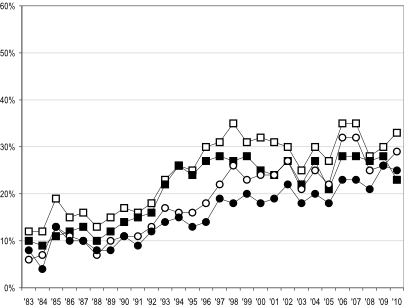
In an OFSTED report (2007)4, which drew heavily on SHEU findings, we showed very clear signals that young people's main source of sex information had undergone a profound shift from the home and towards school lessons. The question was dropped as 'standard' in 2005, however, the charts 1 & 2 below have been extended to 2010 with more recent data from smaller samples.
Chart 1. The percentages of pupils stating that their main source of sex information
is from parents, 1983–2010
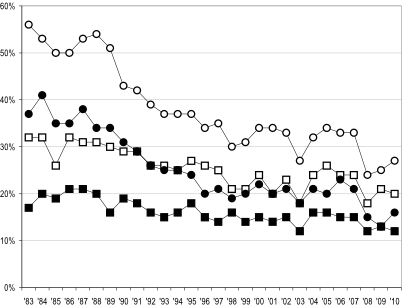
—o — Yr 8 M —¡ — Yr 8 F —n — Yr 10 M —l — Yr 10 F
Chart 2. The percentages of pupils stating that their main source of sex information
is from teachers or lessons, 1983–2010
1 UK Young People's Parliament (2008). Are you getting it? London: UKYP.
2 Sex Education Forum (2008). Key findings: Young people’s survey on sex and relationships education. London: NCB/SEF.
3 Sex Education Forum (2011). Young people’s experiences of HIV and AIDS education. London: NCB/SEF.
4 OFSTED (2007). Time for Change? Personal, social and health education. London: OFSTED.